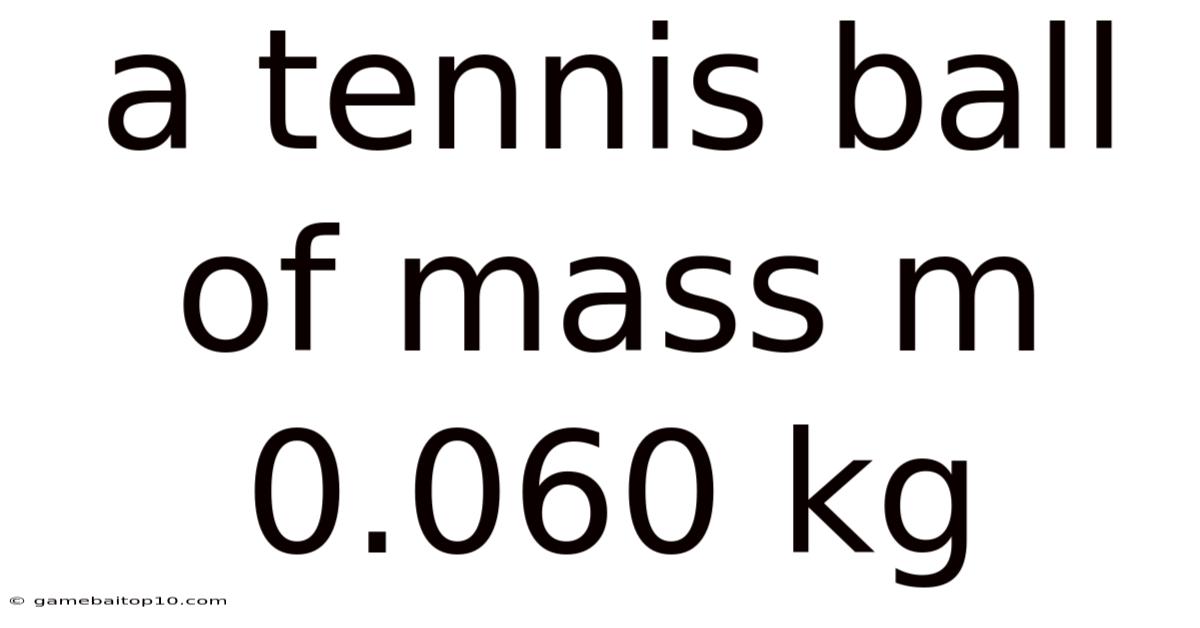
A tennis ball, seemingly simple, encapsulates a fascinating blend of physics, engineering, and sporting history. This sphere of mass m = 0.060 kg, typically bright yellow-green, is meticulously designed to deliver consistent performance, influencing the dynamics of every serve, volley, and groundstroke on the tennis court Worth keeping that in mind..
Not obvious, but once you see it — you'll see it everywhere.
The Anatomy of a Tennis Ball
A tennis ball isn't just a hollow rubber sphere. Its construction is a carefully orchestrated process involving several key components and stages. Understanding these elements reveals the science behind its bounce, flight, and overall playability.
-
Rubber Core: The heart of the tennis ball is its rubber core. This is often made from a blend of natural and synthetic rubber compounds. The precise formulation dictates the ball's compression and rebound characteristics. Different blends are used for different playing conditions (e.g., hard courts vs. clay courts) and altitude. The core is molded into a hollow sphere and then vulcanized (heated with sulfur) to harden it and give it its initial bounce Small thing, real impact..
-
Felt Covering: The rubber core is then covered with two figure-eight shaped pieces of felt. This felt is typically made from a blend of wool and synthetic fibers (nylon or polyester). The quality and thickness of the felt significantly affect the ball's durability, aerodynamics, and playability. A denser felt will generally last longer and provide a more consistent bounce. The felt pieces are glued onto the rubber core using a strong adhesive, and the seam where they meet is carefully sealed.
-
Pressurization (Optional): While not all tennis balls are pressurized, most tournament-grade balls are. Pressurization involves injecting the ball with compressed air or gas (typically nitrogen) during the manufacturing process. This internal pressure gives the ball its lively bounce. Pressurized balls offer superior performance but gradually lose pressure over time, especially after the can is opened, leading to a decrease in bounce. Non-pressurized balls, often called pressureless balls, rely solely on the elasticity of the rubber core for their bounce. They are more durable but have a less lively feel Less friction, more output..
The Physics of a Tennis Ball's Bounce
The bounce of a tennis ball is a fascinating demonstration of several fundamental physics principles. Let's break down the key forces and energy transformations involved:
-
Impact and Compression: When a tennis ball hits the ground or a racquet, it undergoes rapid compression. The ball's shape deforms significantly as the kinetic energy (energy of motion) is converted into elastic potential energy (energy stored in the deformation of the ball). The amount of compression depends on the ball's internal pressure (if any), the rubber core's elasticity, and the velocity of the impact And that's really what it comes down to..
-
Restitution and Rebound: As the ball reaches its maximum compression, it begins to return to its original shape. The stored elastic potential energy is converted back into kinetic energy. This energy propels the ball upwards, causing it to rebound. The coefficient of restitution (COR) is a measure of how efficiently the ball returns its energy during the bounce. A COR of 1.0 indicates a perfectly elastic collision (no energy loss), while a COR of 0.0 indicates a perfectly inelastic collision (all energy is lost). Tennis balls typically have a COR between 0.70 and 0.85. Factors such as the ball's temperature, surface type, and spin affect the COR.
-
Energy Loss: The bounce of a tennis ball is never perfectly elastic; some energy is always lost during the impact. This energy loss is primarily due to:
- Friction: Friction between the ball and the surface converts some of the kinetic energy into heat.
- Deformation: The deformation of the ball generates internal friction within the rubber and felt, also converting kinetic energy into heat.
- Sound: A small amount of energy is dissipated as sound waves.
-
Spin and its Effect: The spin imparted on the ball significantly influences its trajectory and bounce.
-
Topspin: Topspin is a forward rotation of the ball. When a topspin ball bounces, the forward rotation causes it to grip the surface more, resulting in a higher and faster bounce with increased forward momentum. Topspin also creates a pressure difference around the ball in flight (due to the Magnus effect), causing it to dip downwards, allowing players to hit the ball harder while still keeping it within the court boundaries.
-
Backspin (Underspin): Backspin is a backward rotation of the ball. When a backspin ball bounces, the backward rotation causes it to skid along the surface, resulting in a lower and slower bounce with decreased forward momentum. Backspin also creates a pressure difference around the ball in flight, causing it to lift upwards, which can be used to create shorter angles and drop shots That's the part that actually makes a difference. Worth knowing..
-
Aerodynamics of a Tennis Ball in Flight
The flight of a tennis ball is governed by aerodynamic forces, primarily drag and lift. Understanding these forces is crucial for comprehending how players control the ball's trajectory and speed.
-
Drag: Drag is the force that opposes the motion of the ball through the air. It is caused by the air resistance against the ball's surface. The amount of drag depends on the ball's size, shape, speed, and the air's density. The felt covering of a tennis ball plays a critical role in its drag characteristics. The fuzzy texture of the felt creates a turbulent boundary layer around the ball, which reduces the pressure drag and allows the ball to travel further. A smooth ball would experience higher drag and would not travel as far Simple, but easy to overlook..
-
Lift (Magnus Effect): Lift is the force that acts perpendicular to the direction of motion. In the case of a spinning tennis ball, lift is generated by the Magnus effect. The Magnus effect occurs because the spinning ball drags a layer of air around with it. On the side of the ball where the rotation is in the same direction as the airflow, the air is accelerated, resulting in a decrease in pressure (Bernoulli's principle). Conversely, on the opposite side of the ball, where the rotation opposes the airflow, the air is decelerated, resulting in an increase in pressure. This pressure difference creates a net force perpendicular to the direction of motion, which is the lift force. Topspin generates a downward lift force, causing the ball to dip. Backspin generates an upward lift force, causing the ball to rise Turns out it matters..
Factors Affecting Tennis Ball Performance
Several factors can influence the performance of a tennis ball, impacting its bounce, speed, and overall playability.
-
Temperature: Temperature significantly affects the properties of the rubber and the air pressure inside the ball (if pressurized). Higher temperatures increase the internal pressure and the elasticity of the rubber, resulting in a higher bounce and a faster ball speed. Conversely, lower temperatures decrease the internal pressure and the elasticity of the rubber, resulting in a lower bounce and a slower ball speed.
-
Altitude: Altitude affects the air density. At higher altitudes, the air is less dense, resulting in less drag on the ball. This allows the ball to travel faster and further. Still, the lower air density also reduces the Magnus effect, which can affect the ball's spin and trajectory.
-
Surface Type: The type of court surface affects the ball's bounce and spin. Hard courts generally produce higher and faster bounces compared to clay courts. Clay courts tend to absorb more energy from the ball, resulting in a lower and slower bounce. The surface also affects the amount of spin the ball can generate. Clay courts offer more grip, allowing players to impart more spin on the ball.
-
Humidity: Humidity affects the air density and the moisture content of the felt. High humidity increases the air density, which can slightly increase drag. It can also cause the felt to absorb moisture, making the ball heavier and affecting its bounce and feel.
-
Ball Age and Wear: Over time, tennis balls lose their pressure (if pressurized) and their felt wears down. This reduces the ball's bounce, speed, and spin. The felt can also become matted and dirty, which affects its aerodynamic properties Easy to understand, harder to ignore..
The Manufacturing Process in Detail
The manufacturing of a tennis ball is a precision process that requires careful control of materials, temperature, and pressure.
-
Rubber Core Production: The rubber core is made from a blend of natural and synthetic rubber, along with various additives that control its hardness, elasticity, and durability. The rubber compounds are mixed in large mixers, and then the mixture is extruded into a sheet. The sheet is then cut into circular pieces, which are molded into hollow hemispheres. Two hemispheres are then joined together to form a hollow sphere. The sphere is then vulcanized in a mold under high temperature and pressure. This process hardens the rubber and gives it its initial bounce Simple, but easy to overlook..
-
Felt Preparation: The felt is made from a blend of wool and synthetic fibers. The fibers are carded (aligned) and then woven into a fabric. The fabric is then treated with dyes and finishes to give it its characteristic color and texture. The felt is then cut into figure-eight shaped pieces, which are slightly larger than the rubber core.
-
Adhesion and Covering: The rubber core is roughened to provide a better surface for adhesion. A strong adhesive is applied to both the rubber core and the felt pieces. The felt pieces are then carefully wrapped around the rubber core, ensuring that they are properly aligned. The seam where the felt pieces meet is then sealed with a special tape or adhesive.
-
Pressurization (If Applicable): For pressurized balls, the ball is injected with compressed air or gas through a small valve. The valve is then sealed. The pressure inside the ball is carefully controlled to meet the specifications of the tennis governing bodies Nothing fancy..
-
Inspection and Testing: The finished balls are inspected for defects and tested for size, weight, bounce, and compression. Balls that do not meet the specifications are rejected Worth knowing..
-
Packaging: The balls are then packaged in pressurized cans or containers to maintain their pressure and prevent them from deteriorating Not complicated — just consistent..
Regulations and Standards
The International Tennis Federation (ITF) sets strict regulations regarding the specifications of tennis balls used in sanctioned tournaments. These regulations ensure fair play and consistent performance. Key regulations include:
- Diameter: The diameter of a tennis ball must be between 6.54 cm (2.57 inches) and 6.86 cm (2.70 inches).
- Weight: The weight of a tennis ball must be between 56.0 grams (1.98 ounces) and 59.4 grams (2.10 ounces).
- Bounce: When dropped from a height of 254 cm (100 inches) onto a concrete base, a tennis ball must bounce between 135 cm (53 inches) and 147 cm (58 inches).
- Deformation: A tennis ball must meet specific deformation requirements when compressed under certain loads. This ensures that the ball has the correct amount of "give" and doesn't feel too hard or too soft.
These regulations are regularly reviewed and updated to reflect advancements in materials and manufacturing technologies The details matter here. Surprisingly effective..
The Future of Tennis Ball Technology
The evolution of the tennis ball continues with ongoing research and development focused on improving performance, durability, and sustainability. Some key areas of innovation include:
-
New Materials: Researchers are exploring new rubber compounds and felt materials that offer improved bounce, durability, and resistance to wear. This includes investigating more sustainable and eco-friendly materials to reduce the environmental impact of tennis ball production Took long enough..
-
Enhanced Aerodynamics: Engineers are using computational fluid dynamics (CFD) to optimize the ball's surface texture and design for improved aerodynamics. The goal is to reduce drag, increase lift, and enhance the ball's spin characteristics.
-
Smart Tennis Balls: The integration of sensors and microelectronics into tennis balls is a growing area of interest. Smart tennis balls could provide real-time data on ball speed, spin, and trajectory, which could be used for training and performance analysis.
-
Recycling and Sustainability: The tennis industry is increasingly focused on reducing the environmental impact of tennis balls. This includes developing recycling programs for used tennis balls and exploring biodegradable materials.
FAQ About Tennis Balls
-
How long does a tennis ball last?
The lifespan of a tennis ball depends on several factors, including the type of ball (pressurized vs. pressureless), the frequency of play, the court surface, and the playing style. Pressurized balls typically last for a few hours of play before losing their bounce. Pressureless balls can last much longer but may gradually lose their liveliness.
-
**Why do tennis balls lose their bounce?
Pressurized balls lose their bounce because the gas inside gradually leaks out over time. That's why this reduces the internal pressure, making the ball less responsive. The felt can also become worn and matted, which affects the ball's bounce and aerodynamics.
-
**Can you revive a dead tennis ball?
Real talk — this step gets skipped all the time.
There are some methods that claim to revive dead tennis balls, such as using a tennis ball pressurizer. These devices can re-pressurize the balls to some extent, but the effect is usually temporary.
-
**Are all tennis balls the same size and weight?
No, there is a slight range of acceptable sizes and weights according to ITF regulations. Still, the variations are small and typically do not significantly affect the ball's performance Not complicated — just consistent..
-
**What is the difference between different types of tennis balls?
Tennis balls are available in various types, including regular duty (for soft courts), extra duty (for hard courts), high altitude, and pressureless. Each type is designed for specific playing conditions and levels of play No workaround needed..
-
**Are tennis balls recyclable?
Yes, tennis balls can be recycled, although it is not always easy to find recycling programs. Some organizations collect used tennis balls and repurpose them into new products, such as playground surfaces and equestrian footing Worth keeping that in mind. That alone is useful..
Conclusion
The humble tennis ball, with its precise mass of m = 0.Understanding the science behind the bounce, spin, and flight of a tennis ball allows players and enthusiasts to appreciate the complex details that make this seemingly simple object such an integral part of the sport. Worth adding: 060 kg, is a marvel of engineering and physics. Day to day, from its carefully crafted rubber core and felt covering to the complex aerodynamic forces that govern its flight, every aspect of the tennis ball is designed to deliver consistent performance and enhance the game. As technology continues to advance, we can expect even more innovations in tennis ball design, leading to improved performance, durability, and sustainability.
